You did everything right.
You bought the buyer data. You sent two hundred emails. You followed up on WhatsApp. You called the numbers that had numbers. And after weeks of this, you had three replies to show for it — and two of them were agents looking for commission.
So you did what most exporters do. You blamed the data.
I’ve spent more than two decades building digital presence for businesses across six countries — long enough to have watched buyer behaviour change from before Google’s Panda update in 2011, through the entire SEO era, and now into the shift toward AI-driven, generative search. I’ve done this for brand-new exporters and for an export company doing over a million dollars a year. And underneath every technology shift I’ve ever seen, one thing has never changed: in the end, it is not a bot or an algorithm deciding whether to work with you. It is a human being, deciding whether to trust you. Everything else is just the surface.
That is the lens this whole article is written through. So let me show you the moment where that trust is actually won or lost — a moment you have never seen, because it happens when you are not in the room.
The short version
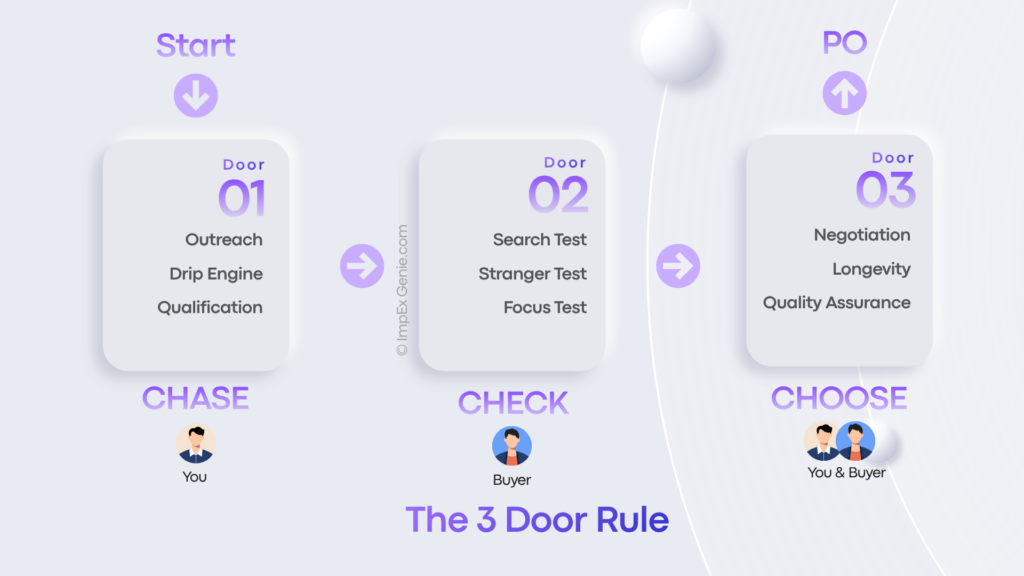
If you only read one paragraph: export buyers go silent not because of your price or your product, but because of what they find when they quietly investigate you after reading your email. Every export deal passes through three doors — CHASE (you reaching the buyer), CHECK (the buyer investigating you), and CHOOSE (the buyer deciding). Most exporters pour all their effort into CHASE. The deal is actually won or lost at CHECK — a step that happens in silence, where you are not present. I call this the 3-Door Rule, and the rest of this article explains how to pass the door that matters.
The buyer you never meet
Picture a buyer in London. Call him Mr. John. It is 11 PM. He opens his inbox and finds forty emails from Indian exporters, all of them promising the same three things: best quality, best price, best service.
He deletes thirty-eight of them in under a minute.
He has not checked your price. He has not asked for a sample. He has not compared your product to anyone else’s. So how did he decide which two to keep?
He decided on something you cannot see from your side of the screen. And whatever it was, it had nothing to do with how hard you worked to reach him.
This is the problem with how most new exporters think about getting buyers. They believe the game is about reaching the buyer. It isn’t. Reaching the buyer is the easy part. The game is decided one step later — and that step is invisible to you.
What is the 3-Door Rule?
The 3-Door Rule is a framework I developed for export marketing, after seeing the same pattern in case after case. It states that every export order passes through three doors, in a fixed order: CHASE, then CHECK, then CHOOSE. I gave it a name because naming a thing makes it easier to see — and easier to fix.
Here are the three doors.
Door 1 — CHASE.
This is where you are. Emails, calls, buyer data, follow-ups. This is the door every new exporter stands at, twelve hours a day. It is all doing, all effort, all you. It feels like the whole job. It is only one third of it.
Door 2 — CHECK.
This is where the buyer is — and where you are not. The moment your email catches a buyer’s interest, he does not reply. First, he investigates you. He Googles your company. He opens your website. He looks at your LinkedIn. He notices whether your email came from a company domain or a free Gmail address. This takes about five minutes, it happens in complete silence, and you have no idea it is even happening. You think you are waiting for a reply. You are actually sitting an exam.
Door 3 — CHOOSE.
This is the result. Reply, or no reply. And remember — no reply is also a reply. It is the buyer telling you that you did not pass Door 2.
Here is the line I want you to remember:
The deal is decided in a room where you are not even present.
Everyone pours their energy into Door 1. The deal is won or lost at Door 2. And almost no one is working on Door 2, because almost no one knows it exists.
Does this change once you grow?
You might be thinking this is a beginner’s problem — that once you land a few orders, the doors disappear.
They don’t.
I first mapped this framework out clearly while working with an export company doing over a million dollars a year. Same three doors. Same silent CHECK. The only difference was that they had learned — sometimes by accident — to pass Door 2. So when buyers investigated them, the investigation confirmed the decision instead of killing it.
That is the whole game, and it is simpler than it sounds: the 3-Door Rule is really about winning trust before the deal is ever discussed. A brand-new exporter and a million-dollar exporter face the exact same three doors, because trust works the same way at every size. The new exporter just hits Door 2 harder — because there is nothing built behind it yet. When a buyer checks them, there is nothing reassuring to find, so the silence comes faster.
Let me give you a real example of CHECK being won.
Feb 2025, I was at Gulfood in Dubai — the big food trade show — alongside an export company I work with. On the 2nd day’s dull afternoon, we spent the show talking to buyers about IR-64 and 1121 Basmati rice, carefully noting down what each one actually cared about, and collecting business cards.

A month later, when we ran our email outreach, we didn’t send “best quality, best price.” We wrote to one buyer with the exact specifics he cared about: the average grain length he was targeting (≥8.20 mm, measured on a 50-kernel caliper), and geo-tagged, timestamped photos of the rice before and after cooking. Here’s the part that proves the point: the buyer didn’t even remember meeting us at the show. But the detail in that email was so precisely matched to what he needed that he spotted it, replied, and wanted to talk.
Two things made the difference. First, we didn’t lead with our USP — why should he buy from us. We led with his UBP, his buying problem — we helped him buy the right product well, whether or not it came from us. That non-salesy approach was the actual deal-breaker. Second — and I’ll be honest about this — the technical rice knowledge wasn’t ours. We got it from a rice supplier. Our skill was knowing how to use it: how to turn a buyer’s real expectations into an email that passed his CHECK. When the buyer wanted to negotiate, we structured a joint venture with that supplier so the relationship could last.
That is CHECK, won deliberately. The buyer forgot our faces — and trusted our email anyway.
So let’s talk about how to pass Door 2.
What does a buyer actually check? The three silent questions
When a buyer investigates you at CHECK, he is silently asking three questions. Each one has a simple test you can run on yourself tonight, for free.
1. Can the buyer find you? — The Search Test
The Search Test asks one thing: if a buyer goes looking for a supplier like you, do you appear at all?
Open Google. Search for your own product the way a buyer would: “frozen paratha supplier India,” “brass fittings exporter,” whatever you actually sell. Look at the first two pages of results.
Are you there?
If you are not — and most new exporters are not — then for any buyer who tries to find you independently, you simply do not exist. You can only ever reach buyers by chasing them, one at a time, forever. Passing the Search Test means building a basic, findable presence: a real website that clearly states what you make, and a LinkedIn profile that says what you export in its very first line.
2. Do you look genuine? — The Stranger Test
The Stranger Test asks: if a complete stranger lands on your website and your LinkedIn — with you nowhere around to explain anything — can they tell, in sixty seconds, what you make, how much you can produce, where you ship, and whether you are real?
This is where most exporters quietly fail. A website with stock images pulled from Google. A free Gmail address instead of a company domain. No photos of an actual factory or actual production. No certifications visible. To you, these feel like small things. To a buyer about to risk a large order with a supplier on the other side of the world, they add up to one word: risk. And buyers do not reply to risk. They move to the next email.
Passing the Stranger Test is mostly a weekend of work: a business email on your own domain, your real company name used consistently everywhere, genuine photos of your real operation, and your certifications shown plainly.
3. Do you look serious? — The Focus Test
The Focus Test asks: does your presence make you look like a specialist in the buyer’s exact product and market — or like someone who will sell anything to anyone?
Buyers trust specialists. An exporter whose entire presence is built around one product line, aimed at one type of buyer, in one market, looks far more credible than one who appears to dabble in everything. Showing up everywhere, a little bit, is weaker than showing up in one place, consistently. Passing the Focus Test means choosing your lane and looking like you own it.
You are not failing at outreach
Read those three tests again and notice what they have in common: none of them are about sending more emails. They are about what the buyer finds when he goes looking — which is the one part of the process you have been ignoring entirely.
So here is the reframe I want to leave you with.
You are not failing at outreach. You have been working at the wrong door. You are a doer, and doing is your strength — you have just been pouring all of it into Door 1 while Door 2 sat empty. The good news is that CHECK is also something you can build. It is not a talent you either have or don’t. It is just a different kind of doing, pointed in a direction nobody told you about.
Everyone works the CHASE. The one who works the CHECK wins the CHOOSE.
Your one action tonight: run the Search Test. Google your own product the way a buyer would, and look honestly at what comes up. Whatever you see is what your buyers see. That is your starting point.
Frequently Asked Questions
Why aren’t international buyers replying to my export emails?
In most cases the email itself is fine — it reached the buyer and the buyer read it. The silence comes from the next step: the buyer investigates you (your website, LinkedIn, email domain, and search presence) before replying, and what they find makes them decide you are too much of a risk. This investigation step is what the 3-Door Rule calls CHECK.
What is the 3-Door Rule in export business?
The 3-Door Rule is a framework stating that every export order passes through three stages: CHASE (you reaching out to buyers), CHECK (the buyer silently investigating whether to trust you), and CHOOSE (the buyer deciding to reply or stay silent). Most exporters work only on CHASE, while deals are actually won or lost at CHECK.
How do international buyers find and verify suppliers or exporters?
Buyers search for suppliers or exporters online, then verify them by checking the supplier’s or exporter’s website, LinkedIn presence, email domain, certifications, and whether they appear credible and specialised. They are silently asking three questions: can I find you, are you genuine, and are you a serious specialist in what I need.
How can a new exporter build trust with foreign buyers?
Make yourself findable (appear in search for your product), make yourself look genuine (a proper website on your own domain, real photos, visible certifications, a business email), and make yourself look focused (specialise visibly in one product and market rather than appearing to sell everything). These map to the Search Test, the Stranger Test, and the Focus Test.
Does buyer trust matter for established exporters too, or only beginners?
It applies to everyone. A new exporter and a million-dollar exporter face the same three doors, because trust works the same way at every size. Established exporters simply tend to have already built the things that make a buyer’s investigation reassuring rather than alarming.
I’m building The CHECK Score — a free tool that shows you exactly how your export business looks to a buyer who’s investigating you, scored across all three silent tests: Search, Stranger, and Focus. It’s launching soon.
[Join the early-access list] and you’ll be first to get it — plus I’ll send you the manual version of all three tests right away, so you can start checking yourself tonight.